
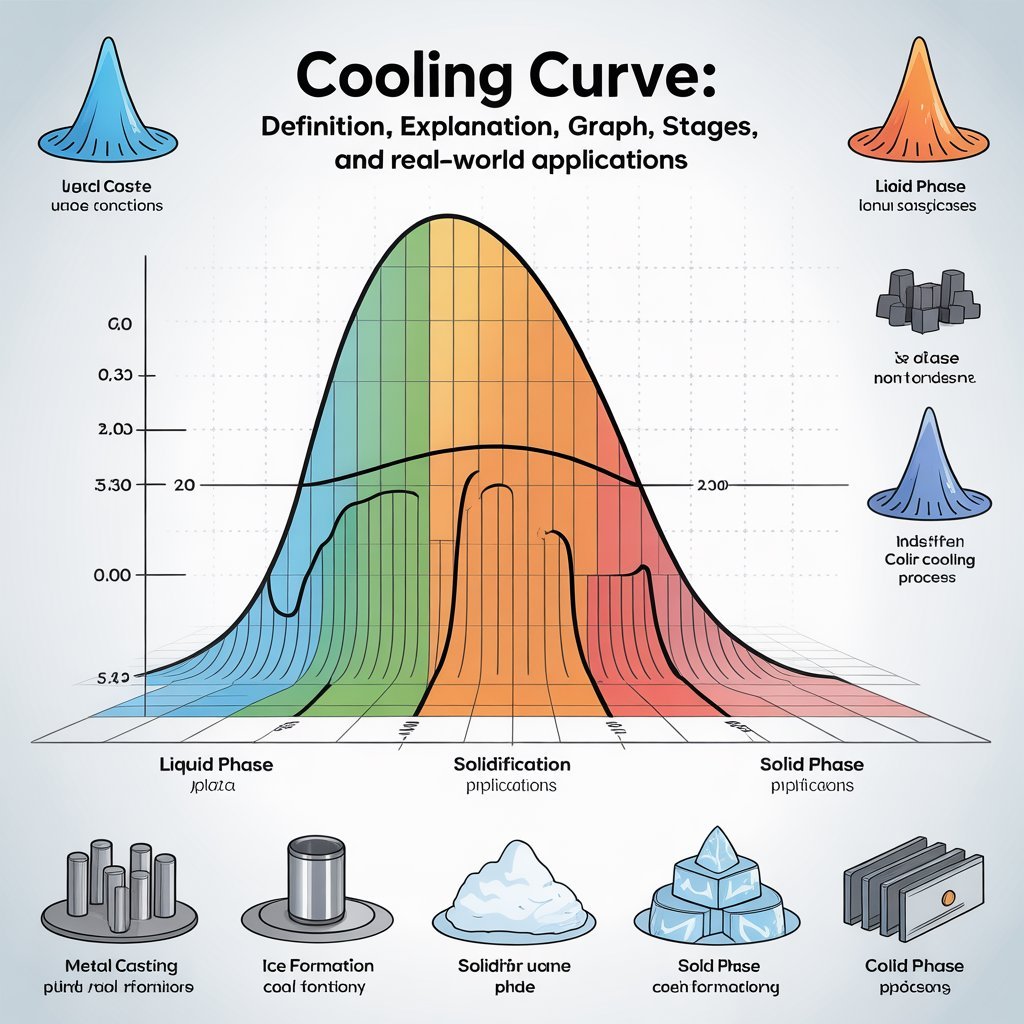
The cooling curve is a fundamental concept in physics, chemistry, and material science that explains how the temperature of a substance changes as it cools over time. It is especially important when studying phase changes such as freezing, solidification, or crystallization. A cooling curve is usually represented as a graph of temperature versus time, and it provides valuable insights into the thermal behavior of pure substances and mixtures. Understanding the cooling curve helps students, researchers, and engineers analyze material properties, predict phase transitions, and design industrial processes such as metal casting, food preservation, and chemical manufacturing. Because of its wide academic and practical relevance, the topic of cooling curves is frequently searched by students preparing for exams and professionals working with temperature-sensitive systems.
What Is a Cooling Curve?
A cooling curve is a graphical representation that shows how the temperature of a substance decreases as heat is removed from it. On the graph, time is plotted on the horizontal axis while temperature is plotted on the vertical axis. As a substance cools, its temperature usually falls steadily until it reaches a point where a phase change occurs, such as liquid turning into solid. During this phase change, the temperature remains constant for a period of time even though heat continues to be removed. This flat or horizontal section of the graph is a defining feature of the cooling curve and represents the release of latent heat. The cooling curve is especially useful for identifying melting points and freezing points of substances, making it an essential tool in laboratory experiments and thermal analysis.
Cooling Curve Graph and Its Components
The cooling curve graph consists of several distinct regions, each corresponding to a different physical state or process. Initially, the curve slopes downward as the substance cools in a single phase, such as a liquid losing heat. This sloping region indicates a decrease in kinetic energy of particles, which results in a lower temperature. As cooling continues, the graph may reach a horizontal plateau where the temperature remains constant. This plateau represents a phase change, typically from liquid to solid, where energy is released as latent heat rather than causing a temperature drop. After the phase change is complete, the curve resumes its downward slope as the solid substance continues to cool. Each of these regions provides critical information about the thermal properties and behavior of the material.
Stages of a Cooling Curve Explained
The stages of a cooling curve can be divided into three main parts. The first stage is the cooling of the substance in its initial phase, such as a liquid cooling above its freezing point. In this stage, the temperature decreases steadily as heat is removed. The second stage is the phase change stage, where the substance begins to solidify. During this stage, the temperature remains constant because the energy being removed is used to change the state of matter rather than reduce temperature. The third stage occurs after the phase change is complete, when the solid substance continues to cool and its temperature once again decreases. These stages clearly illustrate the relationship between heat transfer, temperature change, and phase transitions.
Cooling Curve of a Pure Substance
The cooling curve of a pure substance has a very clear and well-defined shape. When a pure substance cools, it freezes at a single, constant temperature, which is its freezing point. This results in a sharp horizontal line on the cooling curve during the phase change. Examples of pure substances include distilled water, pure metals, and pure chemical compounds. The flat section of the curve is particularly useful because it allows scientists to accurately determine the freezing point of the substance. This property is widely used in chemical identification and quality control, where the purity of a material can be assessed by observing the sharpness of its cooling curve plateau.
Cooling Curve of a Mixture
The cooling curve of a mixture differs from that of a pure substance because mixtures do not usually freeze at a single temperature. Instead of a flat plateau, the cooling curve of a mixture often shows a sloped or curved region during solidification. This happens because different components of the mixture solidify at different temperatures. As a result, the phase change occurs over a range of temperatures rather than at one fixed point. This behavior is important in fields such as metallurgy and food science, where alloys and solutions are commonly used. Studying the cooling curve of a mixture helps engineers and scientists understand how components separate or crystallize during cooling.
Importance of the Cooling Curve in Physics and Chemistry
The importance of the cooling curve lies in its ability to explain thermal processes in a simple and visual way. In physics, cooling curves help students understand concepts such as heat transfer, latent heat, and phase changes. In chemistry, they are used to determine melting and freezing points, analyze substance purity, and study crystallization behavior. Cooling curves are also essential in material science, where they help predict how materials will behave during solidification. By analyzing cooling curves, scientists can optimize experimental conditions and improve the accuracy of thermal measurements.
Applications of the Cooling Curve in Real Life
The applications of the cooling curve extend far beyond the classroom. In the food industry, cooling curves help determine proper freezing methods to preserve texture and nutritional value. In pharmaceuticals, they are used to study crystallization processes that affect drug stability and effectiveness. Even in environmental science, cooling curves play a role in understanding how temperature changes affect natural systems such as lakes and oceans. These real-world applications highlight the practical importance of understanding cooling curves.
Difference Between Heating Curve and Cooling Curve
The difference between a heating curve and a cooling curve lies in the direction of heat transfer and temperature change Although both curves contain flat regions representing phase changes, the energy flow is opposite Understanding both curves provides a complete picture of thermal behavior and phase transitions.
Common Mistakes When Interpreting Cooling Curves
Many learners make common mistakes when interpreting cooling curves, such as assuming temperature always decreases during cooling. The flat sections of the curve can be confusing because temperature remains constant even though cooling continues. Another common mistake is failing to distinguish between pure substances and mixtures, which can lead to incorrect conclusions about freezing points. Mislabeling graph axes or misunderstanding the significance of latent heat are also frequent errors. Avoiding these mistakes requires careful observation of the curve and a clear understanding of the underlying physical principles.
Conclusion
The cooling curve is a powerful and essential tool for understanding how substances lose heat and undergo phase changes. By analyzing the shape of the cooling curve, one can identify key properties such as freezing points, latent heat, and differences between pure substances and mixtures. A strong understanding of cooling curves not only helps students succeed in exams but also supports real-world applications in engineering, manufacturing, and scientific research.
Frequently Asked Questions (FAQ)
What is a cooling curve in simple words?
A cooling curve is a graph that shows how the temperature of a substance changes over time as it cools and loses heat.
What does a flat line on a cooling curve represent?
A flat line represents a phase change, such as liquid turning into solid, where latent heat is released..
What is the difference between a cooling curve of a pure substance and a mixture?
A pure substance has a flat freezing point on its cooling curve, while a mixture usually freezes over a range of temperatures, resulting in a sloped curve.
Can a cooling curve be used to identify a substance?
Yes, the freezing point shown on a cooling curve can help identify a pure substance and assess its purity.
